


News
Blog: Developing an Understanding of Number using the Outdoors
6 November 2026Let’s Go Outside! – Developing an Understanding of Number using the Outdoors
About the Author – Cathy Anderton, (The Early Years Head), Education Consultant
Cathy in an Education Consultant (The Early Years Head) and was previously Head of The Bright Futures Early Years Stronger Practice Hub and a Headteacher at an Outstanding Infant and Nursery School in Trafford. She has a strong background in Early Years education and specialises in supporting young children with a variety of SEND. Cathy has previously worked as an EYFS Consultant for Trafford. During her time working for the Local Authority, she was fortunate to train and work with practitioners from different types of settings across the Early Years Sector including childminders, day care staff and schools.
Cathy also recently delivered an ‘Unlocking Learning for 0-5s Through Block Play’ webinar for the Hub and the recording can be accessed via our website here.

“By providing frequent and varied opportunities to build and apply this understanding – such as using manipulatives, including small pebbles and tens frames for organising counting – children will develop a secure base of knowledge and vocabulary from which mastery of mathematics is built. In addition, it is important that the curriculum includes rich opportunities for children to develop their spatial reasoning skills across all areas of mathematics including shape, space and measures. It is important that children develop positive attitudes and interests in mathematics, look for patterns and relationships, spot connections, ‘have a go’, talk to adults and peers about what they notice and not be afraid to make mistakes.” DfE EYFS Development Matters
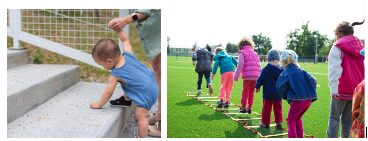
The outdoors offers a wealth of opportunities to support babies’ and young children’s mathematical development. Here are a few ideas that will hopefully offer a bit of inspiration. These predominantly focus on early number concepts – for ideas to support the development of spatial reasoning read the Nursery World article (link provided at the end). Further information and ideas for supporting all aspects of children’s Mathematical Development can be found via the websites and book recommendations provided at the end of this article.
Birth to 3 year olds
| Developing an understanding of number – key concepts include; Noticing changes in quantity when the difference is significant (more than double). Looking for things that have gone from sight. Becoming aware of number names through action songs/ number rhymes. Starting to say some number words – developing into saying these in order. Starting to engage in counting behaviour (https://www.youtube.com/watch?v=sEn_6b-Woqs). Counting on fingers. | Resource suggestions; Treasure baskets. Collections of objects such as large shells, wooden dolly pegs. Blocks and containers for building/ stacking. Collections of boxes with lids, baskets and bowls. Blankets and scarves for hiding and revealing objects – or themselves! Prams and trolleys for transporting thingsSteps, ladders, climbing equipment. Action rhymes/ Number rhymes resources |
Suggested Activities

Hide two groups of objects under blankets – one with just one or two objects, the other with many more. Slowly reveal one pile then the other and look at how the baby responds as you do so. Place the groups of objects slightly away from the baby to encourage them to crawl towards/ reach out and grasp. Use high interest objects and toys.
Use a bubble wand to blow one bubble and say “one bubble” then use it to produce lots of bubbles and say “lots of bubbles”. You can also refer to the size – a big bubble, little bubbles. Let them have a go at blowing bubbles too.
Provide them with collections of objects and containers so they can transfer them from one container to another. Consider using sets of two different resources such as shells and wooden dolly pegs – they may start to sort them.
Count as you go – say the number names as children add more bricks to a tower or take more objects from a basket. Do this for things you can’t see too such as counting while you clap together, as they jump or as they climb steps.
Point and say when you see one or two objects or animals/ birds – eg “Look two dogs” “Look one sunflower”
3-5 Year Olds
| Developing an understanding of number – key concepts include;Subitising groups of objectsLearning the count sequenceOne to one correspondence when counting setsCardinality – knowing the last number said relates to the group sizeRecognising digitsLinking together number words, quantities and the corresponding digits (connection model)Conservation of number – knowing that the group size remains unchanged when the same objects are moved aroundOrdering and comparing numbers and quantitiesKnowing that a number can be made up of other smaller numbers combinedUnderstanding that the next number in the count sequence is the same as adding one moreAdding and subtracting numbers with objects, then withoutUse counting to share/ group objects | Resource suggestionsCollections of natural objects of different shapes and sizes such as shells, pebbles, conkers, pinecones, sticks, leavesDifferent sized containers – baskets, plant pots, buckets and bowlsWashing line and pegsNumber matsLadders, cones, large dice and bean bagsOther games equipment such as bats and balls, hula hoops, skipping ropes etcMud play/ water play/ sand play equipment – different sized jugs, buckets, spoons, spades, bottles etcMark making materials – blackboards and chalk, clipboards, whiteboards and pens, large rolls of paperLarge construction and den building reqources – planks, crates, lengths of guttering, old sheets etcNumber tracks and number lines Tape measures and height chart5 frames and 10 framesSand timers |
Suggested Activities
Subitising opportunities outdoors
The outdoors offers lots of opportunities to develop young children’s ability to subitise. A great activity for 3-4 year olds is to “go on a number hunt” by looking out for groups of a particular size. You could give the children an Ipad/ camera to take photos when they spot groups of two, for instance, while others take photos of groups they spot that are “not two” to compare them with. As with most things you will need to model this first. The pictures could then be displayed together at child height for the children look at and discuss/ sort into two/ not two.
Another simple activity is to give the children frames to mark out when they have spotted a group of a particular size. They could mark them with a bean bag or a digit card with the corresponding numeral on or they could place a frame over them to highlight the group they have found. Simple frames can be made with lolly sticks with sticky Velcro dots on the ends to fit them together. You could extend this by suggesting they use the triangular 3 sided frames when they spot a group of three and the square 4 sided frames when they spot a group of 4. As children start to write numerals they could also be given post it notes or pieces of card to mark the set with the corresponding numeral.

5 frames and 10 frames
Look out for egg boxes that store 10 eggs. These make great tens frames for organising and collecting objects indoors and outdoors and they can be cut across to make five frames. You can also cut up a shower curtain with a grid pattern for making waterproof ones. These are readily available online for a small cost. You can also use sticks for tens frames.

Here are a few ways the frames can be used outdoors;
- Gather a specified number of objects such as leaves and present them on the frame
- Use two types of natural objects, such as conkers and acorns to show different number bonds to ten
- Use found objects to make a repeating pattern on your frame
When supporting children’s developing sense of number, it is important to provide models and images that help them to make the connection between a quantity, the number word and the numeral that represents this quantity. The number track below offers an example of how this might be presented – this is often referred to as the connections model.

The tens frame below shows an example of how resources can be used outdoors to create groups of 1 to 10 objects and how dot representations and numerals relating to each group of objects can be matched to these.

Number games

There are plenty of opportunities for number games outdoors that can be resourced with little effort. These include things like hop scotch, tin can alley or skittles, and target games using tubs or buckets, hoops or chalk markings for targets. Easels, chalk boards and clip boards can be used for keeping score. These offer the chance to introduce children to mathematical mark making, including practising writing digits and introducing tally marks. Children can also be involved in marking out the tracks and targets on the ground too.
Sand timers can be used for comparing how many jumps/ laps of the path/ balls children can throw through a hoop etc.
Exploring shapes and patterns

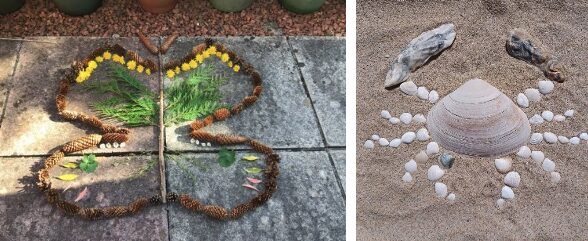
Natural objects offer a wealth of opportunities for transient art outdoors. These activities help to develop children’s sorting, matching, pattern building and counting skills as well as their fine motor and co-ordination skills and creativity. They are a great way to introduce the concept of symmetry. By simply placing a stick down the middle of a paving stone you will see that many children automatically start to create a symmetrical picture or pattern.
Rainbow sticks can be bought online but they can easily be made by gathering straight sticks that are cut into equal lengths, or you can buy 8mm/ 10mm dowel from a hardware store and cut it into equal lengths. The ends of these are then marked in different colours (try 4 or 6 colours). The ends can be marked with paint or coloured tape/ stickers and some may have matching colours each end while others will be mismatched. They can be used to create shapes or lines/ tracks of different lengths and are particularly designed to be used like dominoes, where the ends that touch have to match.

Prompts for the children might include;
- Make the biggest triangle you can using the sticks you have been given. Can you use all of them to make one?
- Make the longest line you can where the ends of each stick match the next one.
- How many squares can you make with your sticks? Did you have any left over?
- Make as many different shapes as you can with your sticks. Label how many sides each one has as you make them using the digit cards.
DfE Help for early years providers
https://help-for-early-years-providers.education.gov.uk
These webpages offer information and videos to support your professional development and practice. They include a section for each of the Areas of Learning. The mathematical development link can be found below.
https://help-for-early-years-providers.education.gov.uk/areas-of-learning/mathematics
Other recommended weblinks
https://educationendowmentfoundation.org.uk/early-years/evidence-store/early-mathematics
Recommended Reading
Developing Young Children’s Mathematical Learning Outdoors – Lynda Keith
Messy Maths A playful, outdoor approach for early years – Juliet Robertson
Children’s Mathematics, Making Marks Making meaning – Elizabeth Carruthers and Maulfry Worthington
50 fantastic Ideas for Maths Outdoors – Kirstine Beeley

144 Irlam Road, Flixton
Manchester M41 6NA
Call us: 0161 823 7073
Link takes you to our Facebook page @Bright-Futures-NW-Early-Years